Green Heron

I feel like I have terrible luck with waterbirds, not that there are many where I'm from, but they should be a lot easier to find considering they're usually pretty big. The green heron has been on my hunting list for a while after I got a split second glimpse of one last fall at the folk festival. Now of course looking at any of my usual spots brought no luck, so when I realized I was going to beavers bend once more for a camping trip, I knew I was going to have to keep an eye out. The pressure was on because I couldn't keep my mouth shut and told everyone I knew that I was hoping to see this particular bird LOL.

Anyways, I was canoeing the river with my family and we left pretty early in the morning so it was plenty misty and overcast. In the first two miles we didn't talk much and just enjoyed the soundscape and scenery of quietly floating down a hazy river. I didn't bring my camera, but it would've made for a beautiful picture. What was amazing is I almost immediately saw green herons everywhere, about every quarter mile they would fly up from the reeds or perch on a low hanging branch.

I'm not sure why they are called green herons, because they are mostly grey and muddy red looking. They're also a very small heron - not to size shame - so I couldn't see them very well as I'd have liked to (see my post on belted kingfisher). Looking at a map it seems Oklahoma is on the very western edge of their range for the US, and they seem to enjoy the coasts, so perhaps they're not as common here as they are in the eastern half of America. I specifically chose a pic with its neck tucked because I think it's funny how they look like early ai pics in real life.

head and wings of a greenish black that looks grey and an almost marroon neck and chest. heron shaped.

Belted Kingfisher

Reflecting on the journey of this blog, I think I became an official birder in 2021 when I first downloaded the Merlin app - and subsequently identified my very first bird (which if I remember correctly was a brown headed cowbird or a brown thrasher). The essence that makes one a birder, instead of just someone that likes birds, is the inherent need to discover and see for oneself. One of my favorite things to do on that app was to look at the "likely in your area" section and daydream about seeing the birds that - to this day - I think were significantly overestimated in prevalence. At the time I lived in Norman, and would always see the belted kingfisher as a glimmering novelty and tantalizing possibility. Often, I would go to the lake in search of this beast, but never ever came close to finding it. Even after moving, and regularly visiting three separate large bodies of water.

I would listen to recordings of its call so I could recognise it if ever I wasn't recording; it has a distinctive rattling call that is said to be unmistakeable. I recently was on a canoeing trip in Beavers Bend and made the informed decision (IYKYK) to leave behind my phone as well as my binoculars glasses. Note: If you want a more aesthetic description of this area, see my green heron entry. But anyways, as I paddle in the water, I hear it, and instantly I know what it is. Once I got a glimpse of the two birds flying across the river, I was surprised cause they were so much bigger than I expected (about the size of a small crow). It had these white wingbars that were pretty flashy when flying. Other than that, the call and the coloring, that was the best I could do to positively ID these birds without being able to see them closely.

It's strange to mark this bird off my list, having put concentrated effort into finding it for three years - in the least. But I feel strangely dissatisfied that I couldn't make out the telltale head crest or see its large beak even though we followed these two birds about a mile down the river. I'm going back to beavers bend in July, and this time I will bring my binos, not caring if I tip the canoe or not!

belted kingfisher: a slate blue bird with a white underbelly and a rust orange 'belt', its got a very large black beak for its size for catching... fish!

American White Pelican

Twas a misty morning. I just came off a nightshift and was feeling good, so I decided to head to Lake Hefner and have myself a look around. This was in the end of September, so it was just a bit chilly and you couldnt see about 20 feet out. Naturally a good morning to go birding. I had a feeling that I would see a cool waterbird though, so continue on I did. For the longest time there wasnt anything good to see - only about 500 coots, a billion seagulls (reminder: make a post about the seagulls of Lake Hefner) and 5 million mallards. i always enjoy the couple of rareities you see there tho: sandpipers, killdeers, herons of all types... but as I was about to turn in LO! Behold the very thing i was hoping to see! a big beautiful pelican!

These things are so much bigger than I thought they were. like, I bet if it was standing next to me it would be able to come up to my chest easily. I looked it up and apparently these are the second largest birds (the condor being the first) in America measuring by wingspan. I think I saw one of the bigger ones cause it was like seeing a ginormous angel all in orange and white. Pelicans are only seen in Oklahoma during migration seasons - which just so happens to be September and some of November. I watched it for a while and even saw it fish (to which it was unsucessful LOL) before it swam to far out and was consumed by the mist, SIGH. I cannot wait for these birds to come back cause it was awesome.

all white pelican with orange beak. its wings are spread and you can see the primairy feathers are black

American Coot

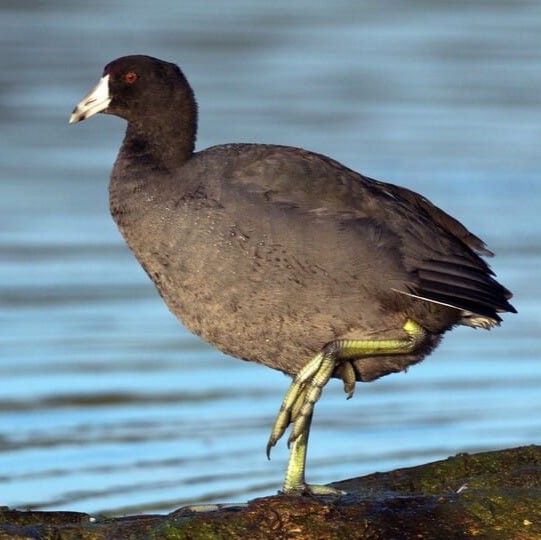
I went to a little fall festival with my sister a couple days ago and we walked around the botanical gardens in the city. On the lake there waere plenty of species of ducks too look at, but we also happed to spot something that was NOT a duck! The american coot! I am not gunna lie, because it was in the water with other ducks, I thought it was also a duck. I looked it up anyway to see if it was a special species or something, and found this cool bird! I kind of wish that we were able to see its legs though. They look like nasty plant matter.

When I looked up its description, the merlin birding app called it "incredibly lobed" which I thought was funny. They also compare it to a chicken - perhaps the author was either especially fond of this species, or a hater. I want to cook and eat their legs.

a black chicken sized bird that looks like a duck had a baby with a piece of seaweed. it has large green segmented feet.